
Impressions from the 28th International Passive House Conference
Last week I attended the 28th International Passive House Conference in Essen, Germany. I saw many dear friends, colleagues and fellow Passive House practitioners, attended many interesting presentations and workshops and had the opportunity to speak about my Passive House experience on my project on Skopelos.
International cooperation is always important and valuable, especially now when global links seem to be breaking. The conference started with the International Passive House Association (iPHA) meeting where I participated on behalf of New York Passive House. We heard updates from Germany, Austria, Bulgaria, Romania, Greece, Italy, Ireland, the UK and South America among others. Many of the international affiliates are making great efforts in advancing Passive House adoption in their regions with training and advocacy and I was really surprised by the hockey stick rate of certified projects in Ireland in 2025 as a result of the country’s larger developer committing to the standard.
I started my second day by visiting the decommissioned Zollverein coal mine and steel production plant. Although there have been great land restoration efforts and a beautiful park and museum, one does not miss the immense scale of the plant and mostly through the exhibits the apparent ghosts of ecological destruction in the effort to power industrialization.
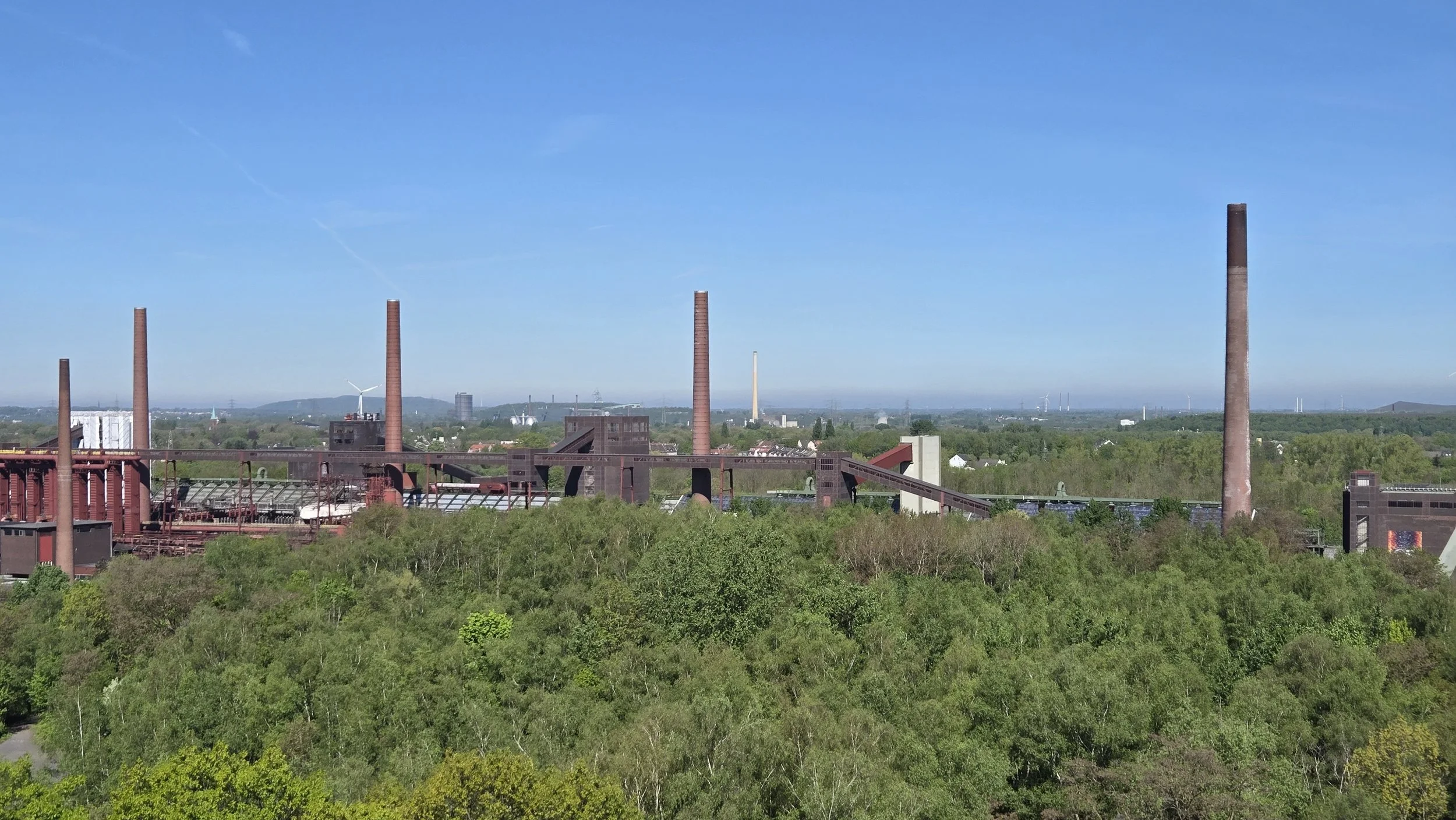
View of the coking facility from the rooftop of the Ruhr Museum at Zollverein
My day continued with two very exciting workshops, one on MEET, an embodied carbon calculator tool created by PHI and the other on the evaluation of summer comfort in temperate climates. The latest version of the PHPP lets us stress test our models for summer comfort and also adjust for future climate, although in a basic way. In my modeling I always try to assume worst case scenarios for cooling and never assume night cooling with natural ventilation as it is highly dependent on correct user execution. It seemed that this was the outcome of the discussion as well.
On my third day is when the conference officially kicked in. The day started with an inspiring plenary from members of the Passive House Institute and local politicians as well as an economics presentation by Prof. Dr. Sigrid Stagl mostly referencing the “Consumption Corridor” as an architectural guiding principle in terms of designing to actual needs that make economic and planetary sense. The presentation of Dimitris Pallantzas and Ilektra Mancini on district level solutions caught my attention mainly about replicability in cities other than Athens. Michael Ingui’s presentation was, as always, inspiring where the basic takeaway is to get Passive House to become an industry standard mostly by specifically not talking about it.
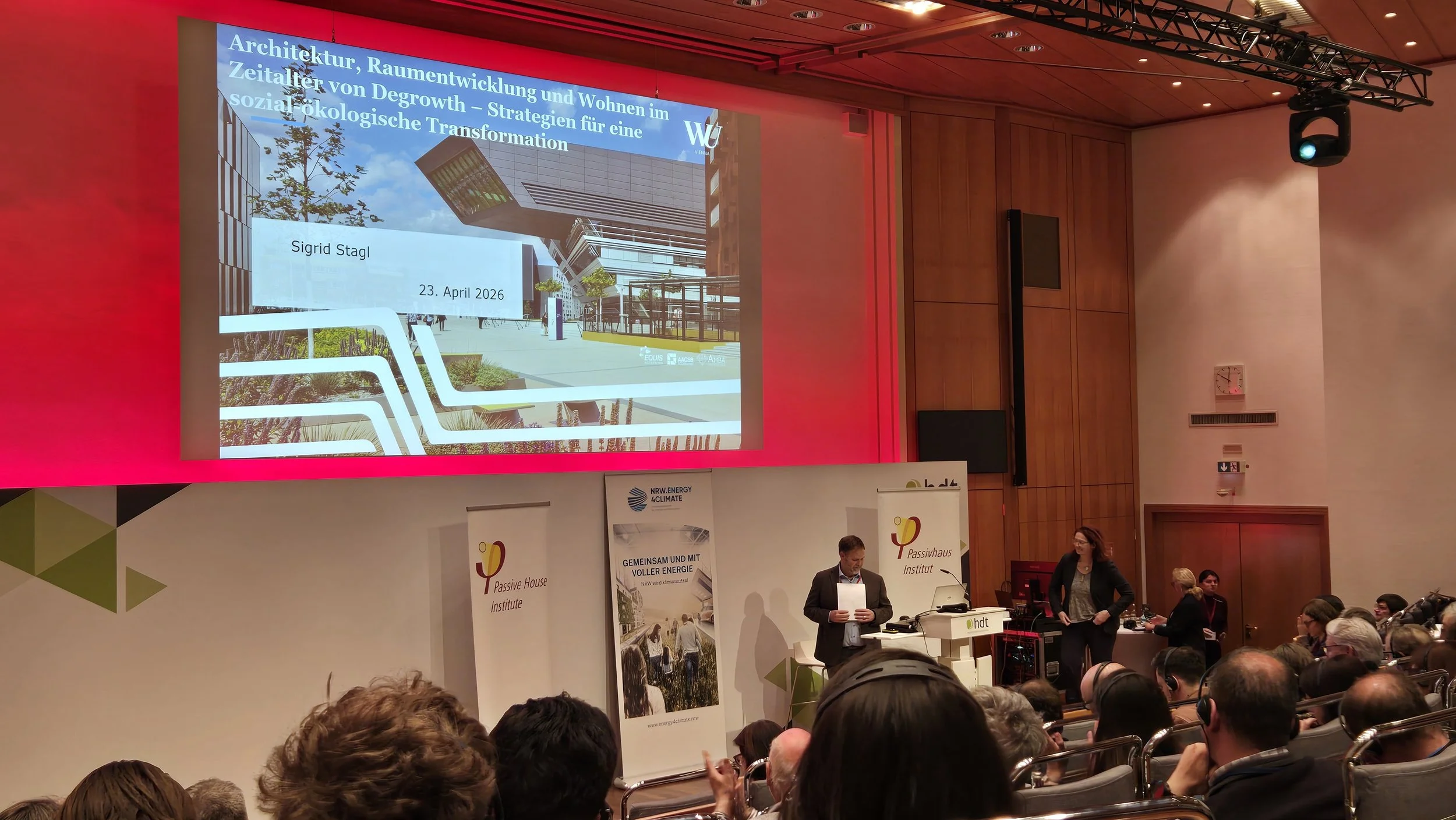
The plenary session at the conference. Prof Sigrid Stagl on degrowth
The Saturday morning sessions that I attended were all about Passive House in warm climates and this is when my session took place. I had the opportunity to talk about the opportunity that the state of the house in Skopelos gave us to retrofit, the challenges that this endeavor had, how we technically solved them and the lessons learned. Other than absolutely enjoying our time on the house, it was highly important for us to measure its performance against our model and were proud to confirm our assumptions. It was an honor for me to present this project in front of experts in the field, especially Wolfgang Feist and the team from the Hellenic Passive House Institute that were instrumental in the success of the project. Thank you Stefan Pallantzas, Dimitris Pallantzas, Ilias Igoumenidis, Nektarios Tsakoumakis, Giorgos Dermentzis and Aris Stavropoulos. I’m looking forward to get the opportunity to do a deeper analysis on the technical solutions for the project and how these can be applied in historic masonry retrofits.
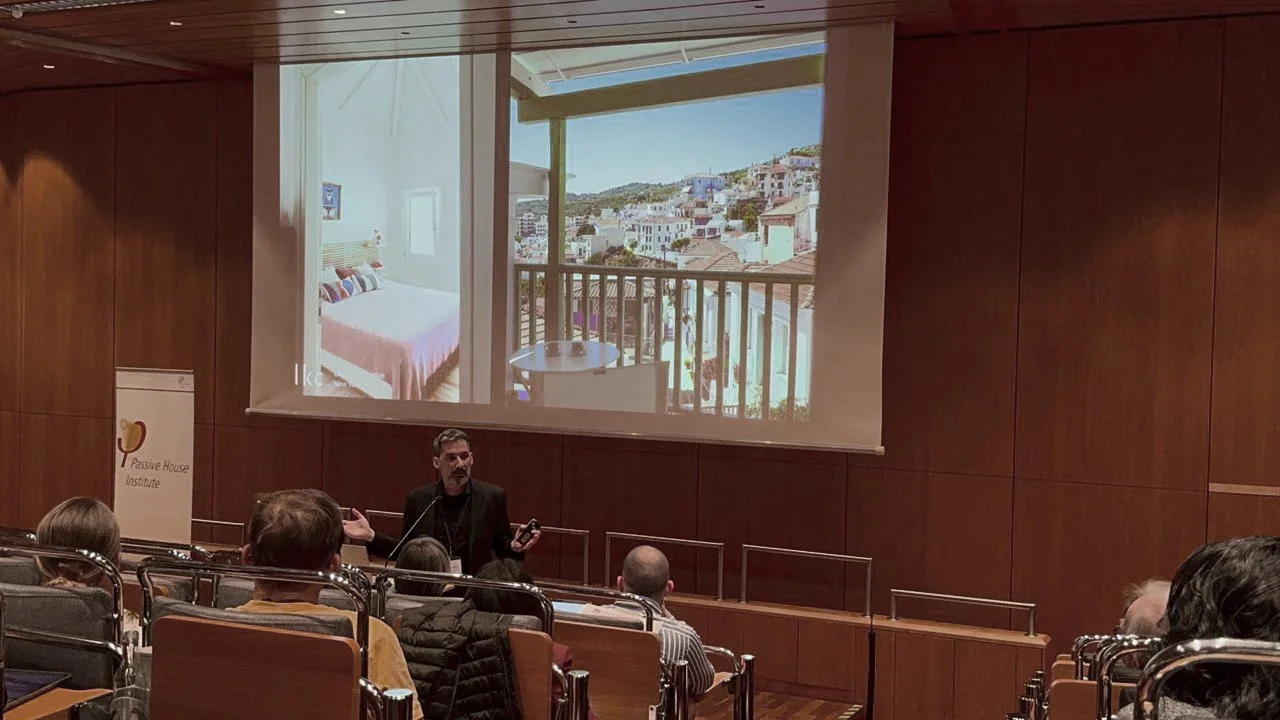
Looking forward to Scott Stewart’s PHPP extension on peak cooling loads coming from Australia to be available for use. The Tavros Project by the Hellenic Passive House Institute is really inspiring as it provides a proof of concept for serial renovation and I found the office energy upgrade that João Gavião did in Portugal extremely inspiring in terms of actions in small scale. It was interesting that although a building is considered to be overheating above 25°C (77°F), all buildings in warmer climates, including my own house, are running at 27°C (80°F) out of occupant choise as any lower temperature feels too cold for the hot months.
The last plenary of the conference was a celebration on 30 years since the Passive House Institute was founded and finished with a lecture from Dr Feist on the history of performance buildings. I was humbled to have my presentation be mentioned as one of the noteworthy of the conference by Jan Steiger, Head of Tool Development at the Passive House Institute right before the closing lecture.
On my last day at the conference I visited 3 district projects, not all certified Passive House nor necessarily performing as such but designed and built with the principles in mind and with high decarbonization goals. The first project, Lönssiedlung, was a tenant-in-place deep energy retrofit of a 1930s housing development that included low rise four to five rental apartment buildings arranged around public gardens in Düsseldorf using the Energiesprong methodology for serial renovation. Prefabrication was selected as a cost and time saving measure with 3 days needed for the installation of the façade from the outside and 3 weeks for all window replacement work from the inside. In the beginning of the project all roofs were built in-place, and soon the team developed prefabricated panels for the roof as well. The buildings that have already been retrofitted have achieved a 90% reduction in heating expenses.
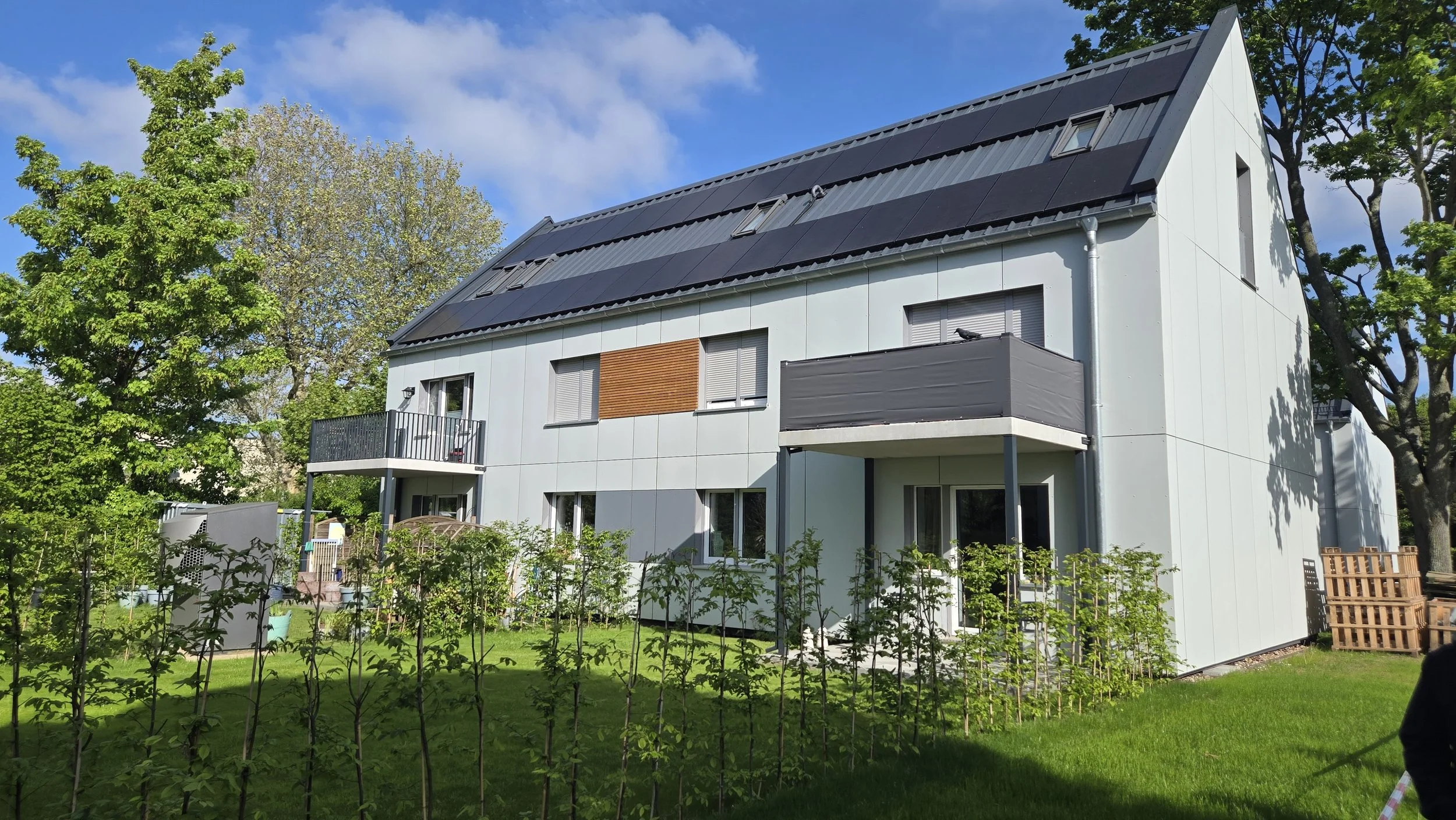
View of the serial renovation project Lönssiedlung in Düsseldorf
The second tour was on a cooperative building arranged around a courtyard with a perimeter loggia overlooking the space. This loggia, as confirmed by the tenants who gave us the tour, amplifies a sense of community while all residents have private balconies on the other side of their apartments. I have extensively discussed this with my business partner at LKC, Brad Leibin, about the success of spaces as such in housing projects. The project, although not certified, has a very low energy demand.
The third project was also a cooperative arranged in two four story building blocks with a very interesting construction method by Zeller Architektur in Cologne. The buildings used a 490mm thick terracotta hollow block filled with mineral wool insulation as the structure where concrete slabs were resting. The construction detailing minimized thermal bridging, provided airtightness and performance through very simple detailing and material economy, which can make projects like that financially viable.
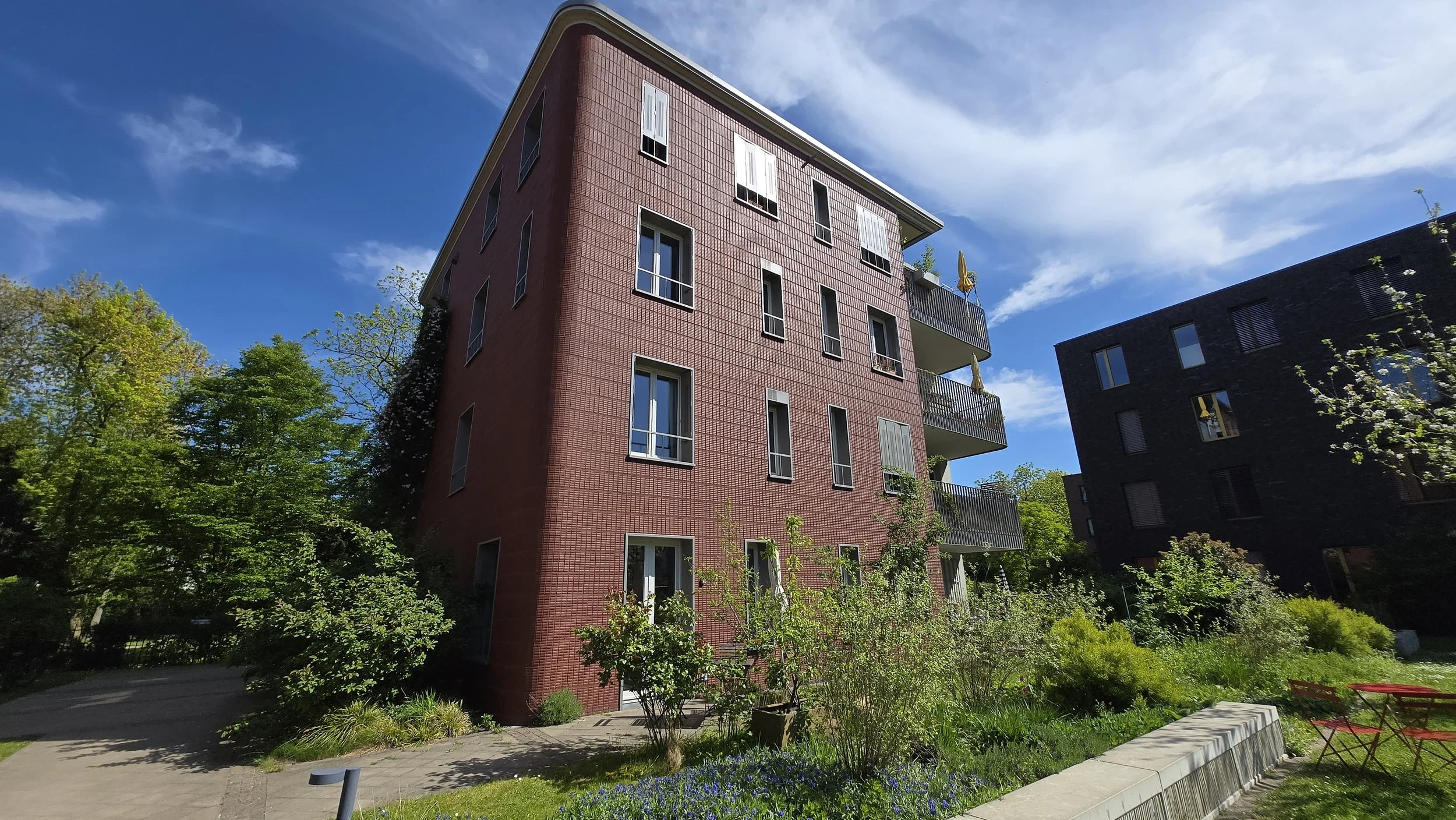
Baugruppe Energie+ project in Cologne
Both cooperative buildings were pretty fascinating as a concept as the residents formed a group before hiring the architect and designing the project. Then everyone had the opportunity to choose their finishes and even design their own kitchens.
None of the buildings that we visited have active cooling, which raises the question about future proofing. Continental Europe will see higher summer temperatures as a result of climate change than costal areas, so one needs to seriously consider whether the design approach needs to change. What is the model that we should be following for future climate? How much should we increase summer temperature and how much should we perhaps lower our winter design temperature, if any. A few years ago I was studying a real estate climate risk model that was mostly focusing on damage due to increased precipitation and wind velocity, so are these future factors that we need to create strategies for?
Passive House buildings have been providing passive survivability so far, weathering winter storms without power, wildfires and heat waves, but in most case they are not completely off-grid buildings. Most are in urban environments that rely on fresh water and sanitation, waste removal and other city services. We as Passive House practitioners should continue to advocate for lowered building emissions through technical, policy and economic solutions.
I leave the conference excited and energized, looking forward to next year’s meeting in Innsbruck, where I hope to get the opportunity to make a different presentation.
